Épanvie
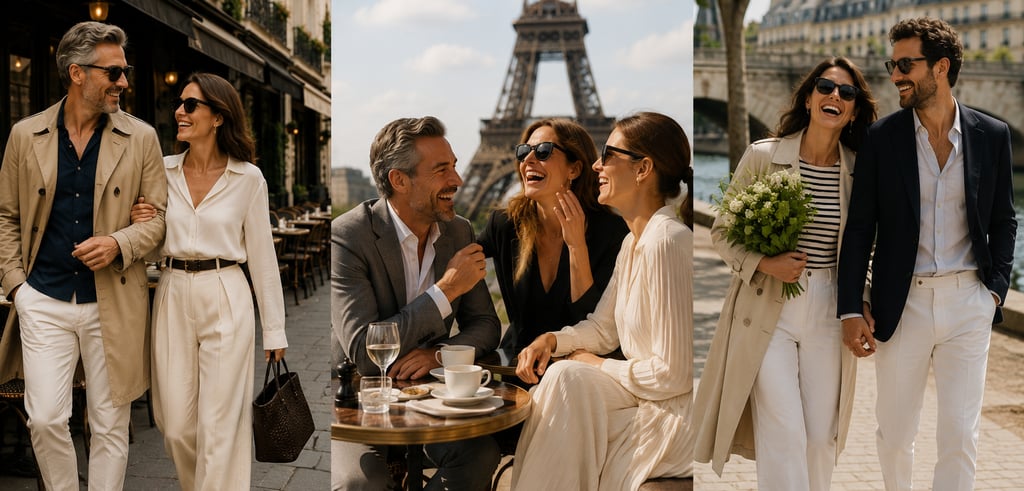
Le Je Ne Sais Quoi The French Art of Effortless Dressing
It isn't a mystery. It's a method — and once you see it, you cannot unsee it.
-By Épanvie Editorial
You know the feeling. You walk into a room and there is one person — man or woman — who looks completely, devastatingly put-together. They are not wearing more. They are not trying harder. They are simply arriving, and the room quietly reorganizes itself around them.
The French have a phrase for this, of course. Le je ne sais quoi. Literally: "I don't know what." The not-knowing is built right into the name, which is either maddeningly unhelpful or deeply poetic depending on your mood. Here at Épanvie, we prefer deeply poetic — and also prefer answers.
Because le je ne sais quoi is not, as it turns out, a quality you are born with like blue eyes or perfect pitch. It is a practice. A philosophy. A specific relationship with clothing, with your own body, and with the radical idea that getting dressed is an act of selection, not accumulation. Those who have mastered it didn't stumble into it. They arrived — slowly, deliberately, elegantly — and you can too.
Pull up a chair. We're going in.
✦
The Myth We Need to Retire Immediately
The fashion industry — bless its relentless optimism — has spent decades convincing you that effortless style is a function of having the right things. The right bag. The right shoes. The right whatever is trending this micro-season. Buy this, look like that. It is a very tidy business model and an almost entirely false premise.
Here is what the genuinely stylish person knows: MomentWatt — the quality of charged presence that makes an outfit feel alive — cannot be purchased. It can only be cultivated. The difference between a wardrobe that generates MomentWatt and one that simply generates receipts is not price point. It is intention.
Consider the approach that has shaped the most enduringly stylish dressers across cultures: fewer pieces, better understood. A well-worn cashmere sweater that has shaped itself to its owner's particular way of crossing their arms. A coat so precisely right that it no longer needs to be thought about. These are not accidents. They are the result of years of what Épanvie calls JuviVelle™ — the Luxury of Selection: the discipline of choosing so well, so slowly, and so personally that what remains needs no explanation.
The opposite — the MomentDrain — is equally recognizable. It is a closet stuffed with things that almost work. Things bought in haste during a sale, or out of obligation, or because someone else looked wonderful in them and you briefly thought the magic might transfer. It won't. It never does. The magic was always in the choosing, not the object.
The most stylish people are not the ones who own the most. They are the ones who know, with startling clarity, exactly who they are — and dress accordingly.
The Six Principles Behind the Look
After considerable study of the phenomenon — conducted from velvet armchairs, Parisian terrasses, and the particularly fruitful observation post of any well-curated fashion archive — we have identified six principles that reliably produce le je ne sais quoi. Not rules. Principles. There is a difference, and the difference matters enormously.
01
They Dress for Themselves First
Le je ne sais quoi begins the moment you stop dressing for approval and start dressing for alignment. Clothing is a form of self-speech, and when what you wear matches who you actually are — your humor, your pace, your appetite for beauty — the outfit stops being a costume and becomes a presence. This is the foundation of BlinkGlee™, the Luxury of Expression: wearing things that genuinely delight you, rather than things that merely signal taste to others.
02
They Practice Deliberate Imperfection
The unbuttoned cuff. The slightly oversized blazer worn as a jacket over a slip dress. The scarf tied with magnificent carelessness that is — make no mistake — not careless at all. Effortlessness in considered dressing is a performance of freedom from effort, which requires its own kind of mastery. One button undone reads as confidence. All buttons done reads as anxiety. The stylish person knows exactly which button is load-bearing and leaves it open accordingly.
03
They Have Resolved the Question of Fit
Nothing eliminates le je ne sais quoi faster than clothing that doesn't fit — but "fit" in the most elegant sense does not mean tailored within an inch of your life. It means resolved. A deliberately oversized piece is resolved. A draped silhouette that pools at the ankles is resolved. What is not resolved is something that is simply too big, or too small, in a way that hasn't been chosen. Visit our curated fashion shop for pieces already selected for their generosity of proportion and quality of drape.
04
They Edit the Atmoswirl
The Atmoswirl is the invisible atmosphere of a look: the collective energy of every piece in an outfit working together. The effortless dresser edits relentlessly. They understand that each addition changes the Atmoswirl — and that more almost always diminishes it. The necklace that seems like it would complete the look is often the thing that collapses it. True elegance frequently involves removing something at the last moment and feeling, counterintuitively, that this is exactly right.
05
They Understand the Role of Texture
Le je ne sais quoi has a tactile dimension that photographs cannot fully capture. The person who looks extraordinary in a simple white shirt and dark trousers is often — if you look closely — wearing a shirt that has extraordinary weight, or a beautiful weave, or a collar that falls just so. Fabric literacy is the silent intelligence behind most effortless dressing. The look says "simple." The fabric says everything else.
06
They Are in FlowCuration™
FlowCuration™ — the Luxury of Attention — means being fully present in what you are doing, including getting dressed. The person who is rushing, distracted, and anxious cannot produce le je ne sais quoi. The wardrobe may be identical. But the quality of attention they bring to assembling it is not. Getting dressed with presence — actually looking, actually choosing — is a practice, and it changes the result in ways that cannot be faked or borrowed.
✦
The Age Question No One Is Asking Correctly
Le je ne sais quoi is frequently discussed as if it belongs exclusively to the young and the long-limbed. This is wrong, and it is wrong in a particularly wasteful way.
The truth is this: effortless style accumulates with age. Every decade of considered dressing adds a layer of authority that cannot be borrowed or manufactured. The person who arrives at forty having spent their thirties genuinely learning what works for them — their proportions, their coloring, their personality's relationship to formality — carries something in their dressing that no trend can compete with. It is the equivalent of compound interest, applied to taste.
This is precisely the audience Épanvie was built for: people who are done experimenting with things that almost work, and ready to invest in selection instead. Those in their twenties and thirties who find us early are simply getting a head start — and we welcome them wholeheartedly into the philosophy.
What the forties, fifties, and sixties offer is this: you already know who you are. Le je ne sais quoi, it turns out, is largely a byproduct of that knowledge expressed through clothing. You are not starting from scratch. You are, if anything, arriving exactly on time.
Every decade of considered dressing adds a layer of authority that no trend can manufacture. This is compound interest, applied to taste.
What It Is Not
In the spirit of precision, let us briefly tour what le je ne sais quoi is definitively not — because the impostors are numerous and occasionally convincing.
It is not expensive clothing. Extraordinary price tags can purchase extraordinary materials, and extraordinary materials do help. But price alone produces nothing except the look of someone who has spent a great deal of money, which is a different look entirely and significantly less interesting.
It is not a signature item. The person who has identified their "thing" — their statement earrings, their recognizable hat — and relies on it exclusively has found a shortcut that eventually reads as a shortcut. Le je ne sais quoi cannot be reduced to an accessory.
It is not a body type. Full stop. The architecture of effortless dressing works in proportion to itself, not in relation to an imagined ideal. The understanding of one's own proportions — and the choice to dress them with specificity and delight — produces the quality we are describing regardless of shape or size.
It is not youth. We have covered this, but it bears repeating, because the fashion industry benefits enormously from the opposite myth and will not correct it voluntarily.
The Épanvie Lexicon at Work
MomentWatt
The charged, magnetic quality of a look that enters the room before the person does. Cannot be purchased, only cultivated.
MomentDrain
The sapping effect of clothing that almost works — bought in haste, worn in obligation, and never quite right.
Atmoswirl
The invisible atmosphere generated by an outfit's totality. Edit one element and you change the Atmoswirl of everything.
JuviVelle™
The Luxury of Selection: the discipline of choosing so well, so slowly, and so personally that what remains needs no explanation.
FlowCuration™
The Luxury of Attention: the practice of full presence — in dressing, in living, in every curated moment.
BlinkGlee™
The Luxury of Expression: the small, genuine delight of wearing something that is entirely, specifically you.
Building Toward It: Where to Begin
If le je ne sais quoi is a practice, then it requires a starting point. Here, in the spirit of Calmebrium — the Épanvie art of intentional presence and quiet ritual — is ours.
The Épanvie Dressing Ritual: Five Minutes That Change Everything
Begin the night before, not the morning of. Place tomorrow's outfit where you can see it. Look at it. Sleep on it. This is not overthinking — it is the opposite of rushing.
Dress in silence, or with music that matches the tone of the day you intend to have. Your nervous system is listening to your dressing the same way it listens to everything else.
When the outfit is assembled, remove one thing. Not the thing you love least — the thing the outfit needs least. These are frequently not the same.
Check proportion, not perfection. Does the silhouette make sense to itself? Does the top half speak intelligently to the bottom half? If yes, you are done.
Leave the house without looking back. Le je ne sais quoi requires a certain confident disregard for its own existence. The moment you start monitoring it, you lose it.
For deeper guidance on building a wardrobe that practices this philosophy daily — one that has solved the morning rather than complicated it — see our piece on The Stylish and Easy Wardrobe Fix. It is the logical companion to everything we've discussed here.
And for those interested in the material intelligence behind all of this — the actual fabrics that drape correctly, breathe beautifully, and age with dignity — our Fashion & Personal Style guide section has the technical grounding that makes considered choices possible.
✦
The Deeper Truth
Here is what we ultimately believe at Épanvie, having turned this question over from every angle and held it up to many different lights.
Le je ne sais quoi is not primarily about clothing. It is about the quality of a person's relationship with themselves — their clarity about who they are, their comfort with that answer, and their willingness to express it rather than hide it. Clothing is simply the most daily, most visible arena in which that relationship plays out.
The people who arrive at this understanding — who stop dressing to manage others' perceptions and start dressing as a form of joyful self-expression — are the ones the room reorganizes around. Not because of what they are wearing. Because of why.
That is the secret. That was always the secret. And now you know it — which means you are already, quietly, on your way.
Questions We Hear Often
Can men have le je ne sais quoi, or is this a women's concept?
Entirely and absolutely not exclusive. The principles described here operate identically across genders — the deliberate imperfection, the resolved fit, the editing of the Atmoswirl. Some of the most compelling examples of effortless dressing in contemporary life belong to men who have understood that style is not a feminine interest but a human one. Épanvie is, always, for everyone who cares about how they move through the world.
How long does it take to develop this quality in one's dressing?
Shorter than you think, if you begin with intention. The MomentDrain clearing — auditing your wardrobe for things that almost work and removing them — often produces an immediate shift. What remains, even if smaller, will begin generating more MomentWatt simply by no longer competing with its neighbors. From there, each considered addition builds fluency. Six months of deliberate practice produces results that are genuinely visible to others.
What is the single most common mistake that prevents effortless style?
Dressing for the person you intend to become, rather than the person you already are. The wardrobe full of aspirational pieces — things purchased for a bolder, thinner, more formal, or more casual version of yourself — is the most reliable generator of MomentDrain. The clothes know. The body knows. Start where you are, dress who you are, and le je ne sais quoi follows with surprising speed.
Is the Sovereign Wardrobe concept related to this?
Deeply related. The Sovereign Wardrobe — Épanvie's proprietary alternative to the tired capsule wardrobe formula — is built entirely on the principles described here: deep self-knowledge, radical editing, and the practice of choosing instead of accumulating. It is le je ne sais quoi, made architectural. Explore it in our fashion section.
Where can I shop pieces that align with this philosophy?
Our Fashion & Accessories shop is curated specifically for this: every piece selected for material quality, proportion integrity, and longevity — the three qualities that make a wardrobe work rather than merely accumulate. Only things that can be worn for years and improve with wearing.
Affiliate Disclosure: Some links within this article may be affiliate links. When you purchase through these links, Épanvie may earn a commission at no additional cost to you. We only recommend products that meet our editorial standards for quality, longevity, and alignment with the Épanvie philosophy. Our editorial opinion is never influenced by affiliate relationships.
Continue Your Épanvie Journey
Fashion & StyleAll fashion guides Wellness & FlowCuration™The attention practice JuviVelle™The Luxury of Selection BlinkGlee™The Luxury of Expression Calmebrium RoutinesIntentional daily rituals The Wardrobe Fix12 pieces, infinite outfits Shop FashionÉpanvie-curated picks Intelligent IndulgenceThe art of choosing well
Private Membership
The Atelier
Épanvie Circle
For those who wish to go further — into community, conversation, and a curated life lived at its fullest expression.
Cercle Essentiel
Cercle Atelier
Cercle Fondateur
Cercle Fondateur is by invitation only · Limited places available
Connect
Your radiant lifestyle starts now
your community
contact@epanvie.com
© 2025. All rights reserved.
PRIVACY AND LEGAL DISCLAIMER.
Content is for informational and entertainment purposes only. Not medical, veterinary, legal, financial, or professional advice. Laws and regulations vary by country. Some content may be fictional. Product is for general information only. Results not guaranteed. We may earn commissions from affiliate links. Full Privacy Policy and Disclaimer for details. Last Updated: [January 19, 2026] Effective Date: [January 10, 2026]
© [2026] Epanvie. All rights reserved.
My post content